
How Bitrix24 Helps Wholesale and Distribution Businesses Run Catalogues, Stock and Repeat Orders in One System
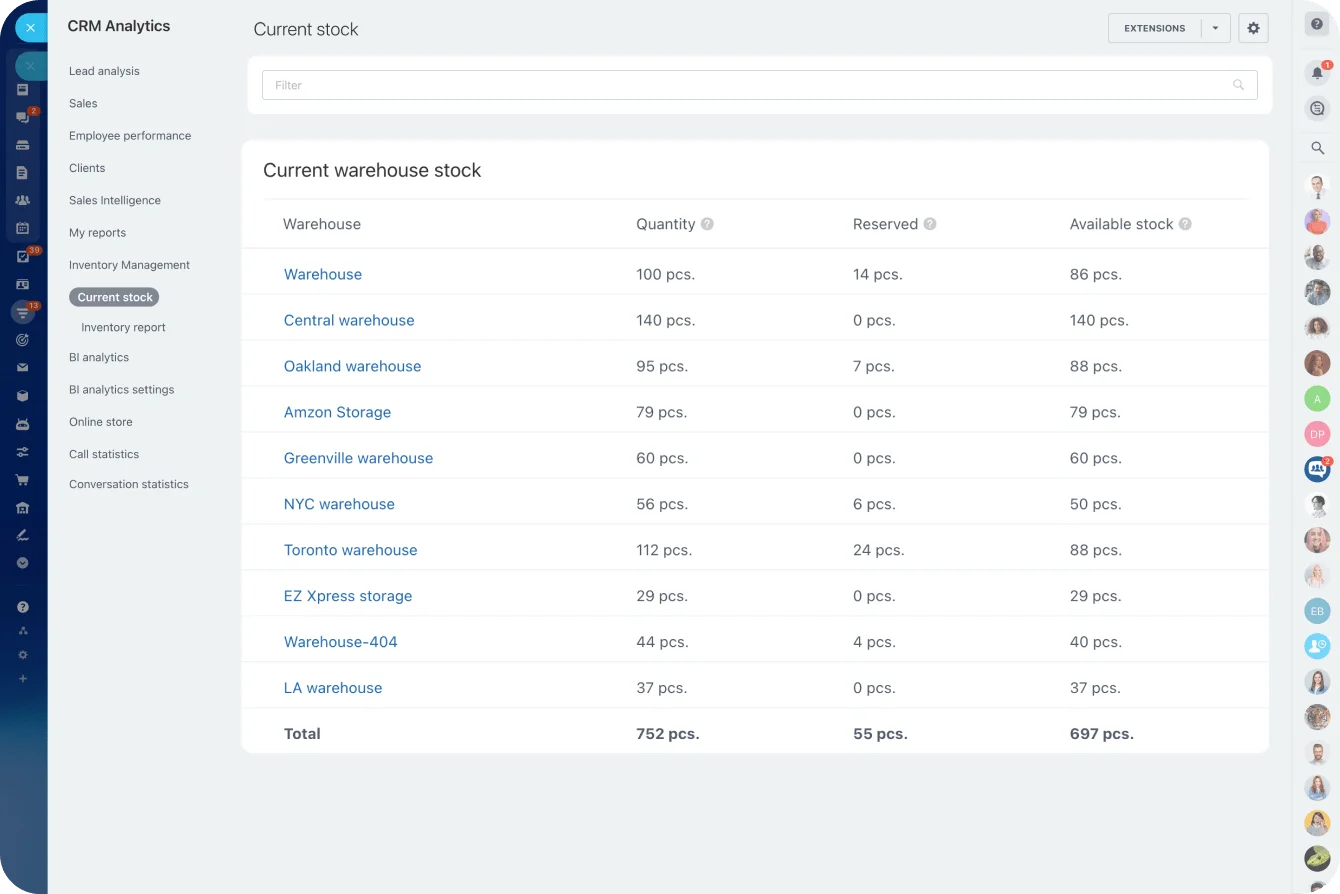
Multi-warehouse inventory management in Bitrix24 · © Bitrix24
A wholesale or distribution business is judged on two numbers that are surprisingly hard to see at the same moment: what a customer owes you, and what is actually on the shelf. Sales quote from a price list in a spreadsheet, the warehouse counts stock in a second system, invoices are raised in accounting software, and the dealer who ordered forty units last month has to be dug out of somebody's inbox. None of those tools is wrong on its own. The trouble is that a distributor's margin lives in the gaps between them — the line quoted at last year's price, the branch transfer nobody recorded, the pro-forma that was never converted into an invoice.
Bitrix24 is worth a look here for a structural reason: its catalogue, its stock ledger and its sales pipeline are the same records rather than three systems bolted together. Everything below comes from Bitrix24's own product pages, listed at the end, and where a claim is Bitrix24's description of its own software it is presented as such.
One catalogue that sales, the warehouse and the storefront all read from
The product catalogue is the spine of everything else. Products are added in a single click, organised into categories and subcategories, and imported in bulk from an existing catalogue — which matters when your SKU list runs to thousands of lines rather than dozens. Units of measurement, discount prices, images and video sit on the product record, and Bitrix24 allows custom fields of your own, giving dimensions and weight as its examples. Those are precisely the attributes a distributor needs for freight quoting and palletisation.
There is also a separate service entity alongside products, so a distributor that bills for installation, calibration or delivery does not have to disguise those as zero-stock SKUs. And because the catalogue is shared rather than copied, the same product record feeds the CRM deal, the inventory ledger and — if you use it — a Bitrix24 online store, instead of being re-keyed into each.
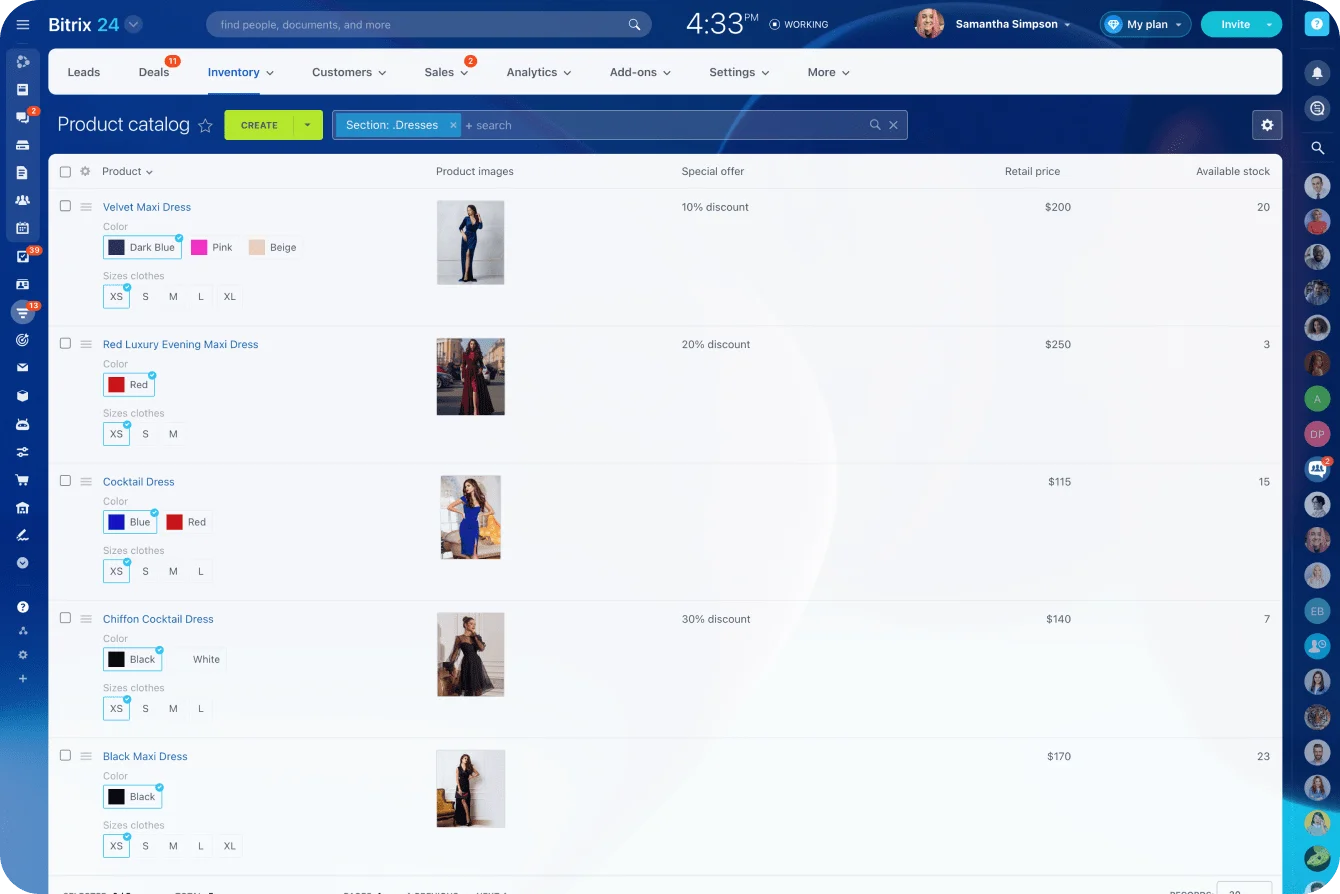
The shared product catalogue behind deals, stock and the storefront · © Bitrix24
Stock traced from supplier to customer, across every warehouse
Bitrix24 describes its inventory management as tracking, auditing and managing stock across multiple warehouses, with every item in the catalogue traceable from the supplier to the customer and status updated in real time. In practice that means a document trail — stock receipts, sales orders, transfers, write-offs and audits — created inside the same system as the deal that caused them.
Transfers are the piece distributors tend to underestimate. If you hold stock in a Jebel Ali warehouse and a showroom in Deira, the question is rarely whether you have an item but where it is and who moved it. Recording transfers as documents rather than phone calls is what makes that answerable on a Tuesday afternoon.
Reporting sits on the same ledger. Bitrix24 lists stock balance, gross profit and gross margin among its inventory reports, so profitability is read off the same records as availability rather than reconstructed in a spreadsheet at month end. Access permissions are then set per employee and per action: who may create products, who may apply discounts, who may edit stock receipts and sales orders, who may change prices and catalogue settings. In a business where a mis-keyed discount is a real cost, that granularity is the whole point.
Quotation to invoice to payment, without leaving the deal
Estimates in Bitrix24 are created in one click from a deal, with the client name, products and amount filled in automatically, and each estimate stays linked to the deal, lead, contact or company it belongs to. They can be worked on a Kanban board, generated from saved templates, and issued automatically by rules and triggers as a deal moves through its stages.
The same logic runs downstream. Invoices are raised from the CRM deal itself, built from templates with custom fields, and can be sent automatically when a deal reaches a chosen pipeline stage. Bitrix24 also lists an integration with Storecove for e-invoicing, which is worth noting as e-invoicing mandates spread across the Gulf. Payments then close the loop: you generate a payment link from the deal, the client pays, you receive confirmation and they receive proof, and payment status is visible on the CRM card in real time. Through CRM Store, Bitrix24 supports cash, card, Apple Pay and Google Pay.
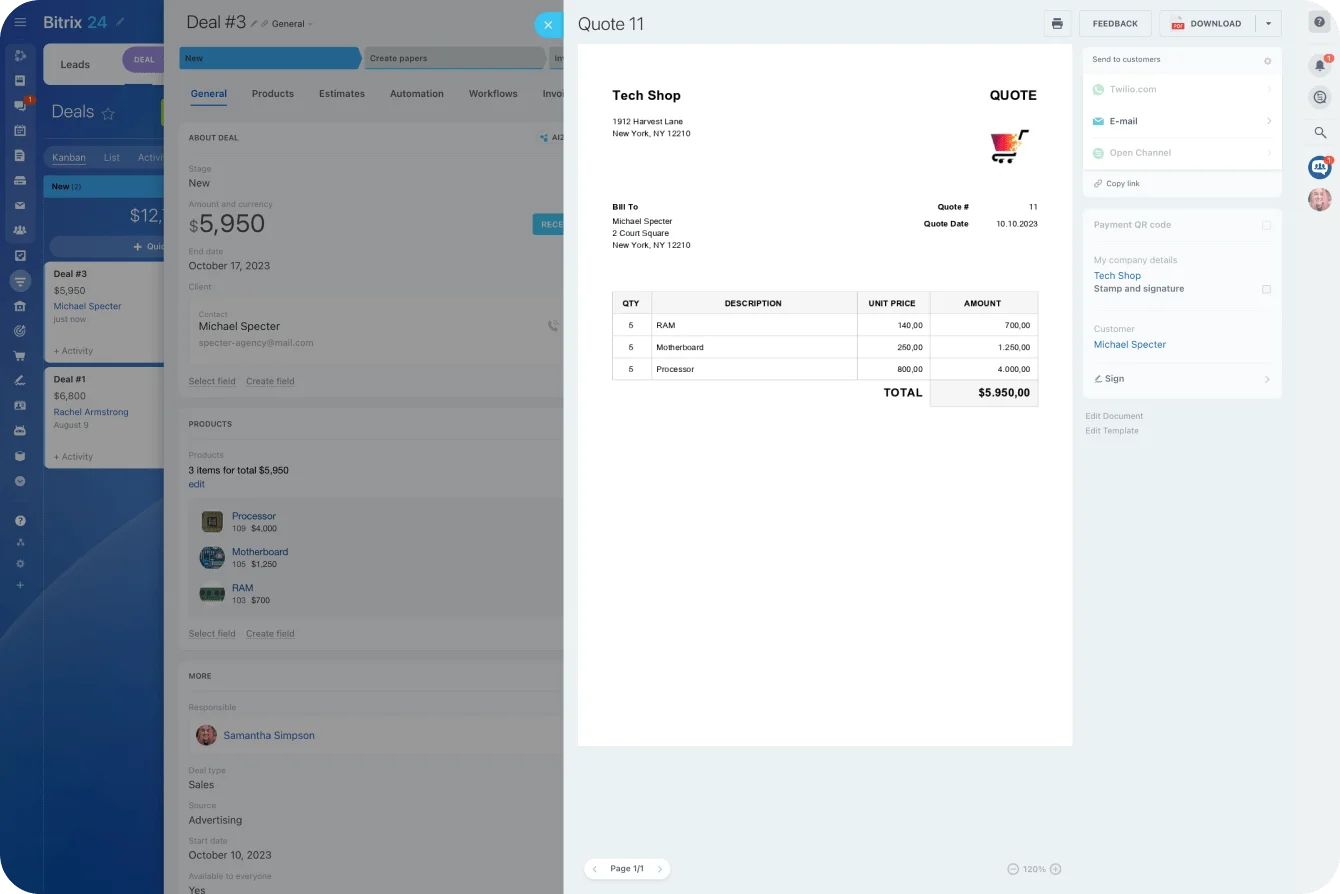
Estimates raised straight from the deal they belong to · © Bitrix24
Pipelines shaped around repeat B2B ordering
Distribution sales are rarely one funnel. Onboarding a new reseller looks nothing like processing the reorder that same reseller places every six weeks, and a tender is different again. Bitrix24 supports multiple pipelines with custom stages, and — usefully — a deal can show different fields depending on which pipeline it sits in, so a reorder card is not cluttered with credit-approval fields it will never use. Related pipelines can then be joined into what Bitrix24 calls sales tunnels, which is how a new-account pipeline hands off to a repeat-orders pipeline instead of duplicating the record.
The contact model suits B2B too. One deal can be linked to several contacts, and one contact to several companies — the buyer, the finance approver and the warehouse contact at a group trading under three entities. Duplicate control and one-click contact import handle the housekeeping that otherwise quietly degrades a distributor database.
Contracts and delivery paperwork signed online
Distribution runs on paper: dealer agreements, credit terms, price-list acknowledgements, delivery notes. Bitrix24 Sign handles these from inside the CRM. Documents are sent for signature by email, SMS or WhatsApp, the signer does not need a Bitrix24 account, and fields can be autopopulated from the deal the document belongs to. Templates can be saved for agreements you issue repeatedly, and Bitrix24 states the tool is UETA and ESIGN compliant.
The warehouse floor, in a phone
Bitrix24 mobile CRM carries inventory, not just deals. Stock adjustments, order management and warehouse transfers can all be done from the app, sales data syncs with inventory in real time, and barcodes can be scanned directly in the Bitrix24 mobile app — something Bitrix24 notes few mobile CRM systems offer. For a storekeeper running a cycle count, that is the difference between a live figure and one that is a day old.
Where a partner comes in
None of this is difficult software, but a distributor configuration is opinionated in ways a generic install is not. Warehouse structure has to mirror how you actually hold stock. Price lists and discount rules have to reflect the tiers you really sell on. The reorder pipeline needs automation that raises the invoice without a salesperson remembering to. Permissions have to stop the wrong person editing a stock receipt. And migrating an existing SKU list with opening stock balances is its own piece of work — one that is expensive to unpick if it is done carelessly the first time.
That is the part B24 Biz Solutions does. As an official Bitrix24 partner working with businesses across the UAE, the wider Middle East and South Asia, we configure product catalogues, multi-warehouse inventory, quote-to-cash automation, dealer document workflows and mobile stock handling around how a distribution business actually trades — rather than around a demo account.
Sources
- Bitrix24 — Sales Enablement: estimates, invoices, payments, product catalog, inventory, Bitrix24 Sign, CRM Store
- Bitrix24 — Sales Management: deals, pipelines, sales tunnels, contact management
- Bitrix24 — Mobile CRM: inventory management and barcode scanning on mobile
- Bitrix24 — Inventory Management In Bitrix24 (product announcement)
- Bitrix24 Helpdesk — Inventory management overview
Want this set up for your distribution business?
We configure Bitrix24 product catalogues, multi-warehouse inventory, quote-to-cash automation, dealer agreements and mobile stock workflows for wholesalers, distributors and trading companies across the UAE, Middle East and South Asia.
Book a free consultation →